What medications are required to be in a crash cart
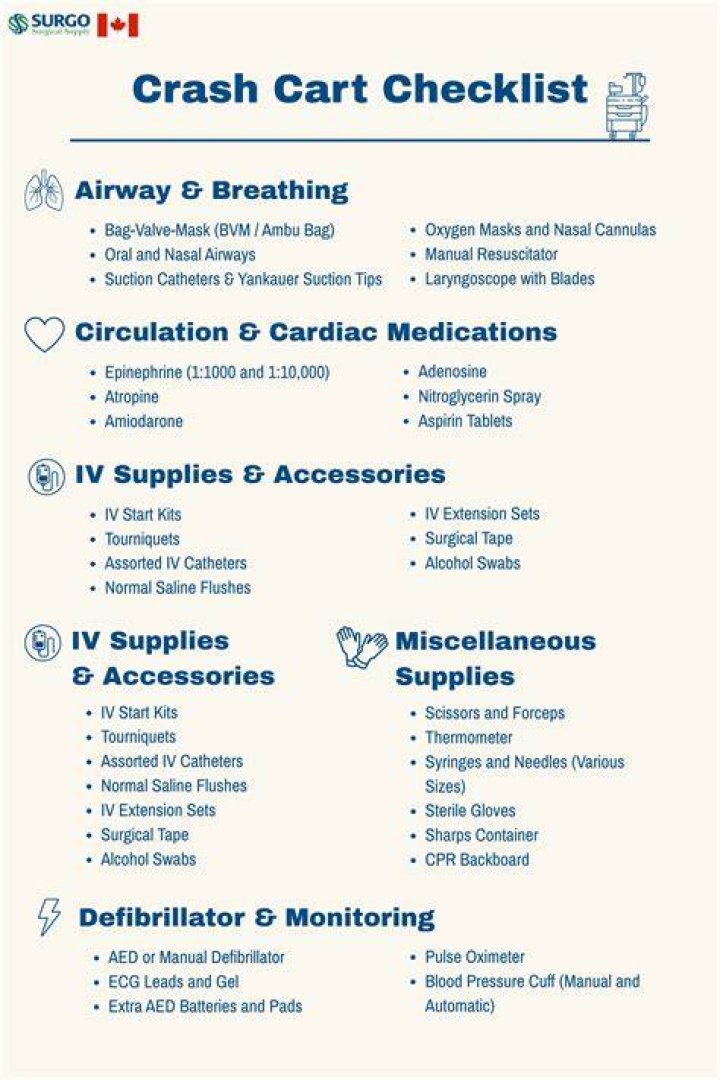
Epinephrine. Epinephrine is the cornerstone of emergency treatment during a code. … Amiodarone. … Atropine. … Calcium. … Sodium Bicarbonate. … Vasopressin. … Dopamine. … Naloxone.
What are the five essential emergency drugs?
- Sedatives and induction agents. 8.3.
- Anticholinergics. 8.4.
- Opioid analgesics. 8.5.
- Anti-emetics. 8.6.
- Corticosteroids. 8.7.
- Anti-epileptics. 8.8.
- Anti-arrhythmics. 8.8.1.
- Anti-hypertensives. 8.10.
What drugs do you give in a code?
- Adrenaline. This is the first drug given in all causes of cardiac arrest and should be readily available in all clinical areas. …
- Amiodarone. …
- Lidocaine. …
- Atropine. …
- Additional drugs. …
- Calcium chloride. …
- Magnesium sulphate. …
- Miscellaneous drugs.
What should be on a crash cart in a nursing home?
- Oxygen and bag-valve masks.
- Nasal cannulas.
- Intubation equipment, including endotracheal tubes of various sizes, laryngoscopes, catheters, stylets, and carbon dioxide detectors.
- Magill forceps.
- Oxygen tank.
What are the other items in a crash cart in addition to medications?
What are the other items in a crash cart, in addition to medications? Syringes and standard IV base solutions. Many large facilities keep a crash cart on each floor or nursing unit, often in a specified location. A life threatening situation in the hospital, such as cardiac arrest.
What is a life saving drug?
The Life Saving Drugs Program (LSDP) pays for specific essential medicines to treat patients with rare and life-threatening diseases.
What are the 10 emergency drugs?
DrugDose (IV)Amiodarone5 mg/Kg IV/IO*Atropine0.02 mg/Kg IV (may give ETT)Calcium Chloride 10%**20 mg/Kg IVDexamethasone0.6 mg/Kg PO/IM/IV
Where are crash carts required?
State regulatory agencies require certain facilities to have a crash cart, but they are recommended for many more. This would include hospitals, outpatient surgery centers, urgent care centers, and all centers where conscious sedation is performed.What are the 20 emergency drugs?
- Adenosine.
- Amiodarone.
- Atropine.
- Dopamine.
- Epinephrine / Adrenaline.
- Naloxone.
- Magnesium sulfate.
- Sodium bicarbonate.
The AHA releases its Guidelines for CPR and Emergency Cardiac Care every five years. These guidelines inform the ACLS crash cart requirements. The list is only a guideline, but most healthcare facilities trust these recommendations and stock their crash carts to their specifications with those guidelines in mind.
Article first time published onWhat meds are pushed during a code?
Epinephrine1 mg q3-5 min. Drip: 0.1- 0.5 mcg/kg/minCalcium Chloride5-10 ml (0.5-1 gm) over 2-5minDopamine5 – 10 mcg/kg/min.Norepinephrine0.1 – 0.5 mcg/kg/minMagnesiumVF/pulseless VT: 1-2 grams/ 10ml D5W over 2-5 minutes.
What does epinephrine do during a code?
Purpose of review: Epinephrine is the primary drug administered during cardiopulmonary resuscitation (CPR) to reverse cardiac arrest. Epinephrine increases arterial blood pressure and coronary perfusion during CPR via alpha-1-adrenoceptor agonist effects.
What drug is given after epinephrine?
Vasopressin should be effective in patients who remain in cardiac arrest after treatment with epinephrine, but there is inadequate data to evaluate the efficacy and safety of vasopressin in these patients (Class Indeterminate).
What are some of the medications commonly stocked in a crash cart quizlet?
Terms in this set (13) According to protocols established by the American Heart Association, some of the medications used for advanced cardiac life support (ACLS) are adenosine, amiodarone, atropine, diltiazem, epinephrine, ibutilde, lidocaine, magnesium sulfate, procainamide, vasopressin and verapamil.
What drugs are found on the emergency trolley?
8) Essential emergency drugs and intravenous solutions were adrenaline, furosemide, insulin, medical oxygen, atropine, antihistamine, magnesium and calcium chloride 10%.
Why is lidocaine in a crash cart?
Lidocaine indications for ACLS It is also useful for the treatment of stable monomorphic VT with preserved ventricular function and for stable polymorphic VT with preserved left ventricular function, normal QT interval, and correction of any electrolyte imbalances.
What is the most frequently used drug in a medical emergency?
Epinephrine represents the most important drug in the emergency kit. Though (hopefully) rarely used, it must be available for administration as soon as possible in the event of an anaphylactic reaction (see Dr. Reed’s article on page 126).
What is dopamine used for in an emergency?
Background/Introduction: Dopamine is a potent, sympathomimetic medication used in emergency medicine and critical care to improve blood pressure (BP) in selected types of circulatory shock and to treat symptomatic bradycardia refractory to atropine and other interventions.
What are the top 10 drugs?
- Vicodin (hydrocodone/acetaminophen) …
- Albuterol (Accuneb, Ventolin, Proair, Proventil) …
- Lisinopril (Generic for Prinivil or Zestril) …
- Levothyroxine (generic for Synthroid) …
- Gabapentin (Neurontin) …
- Metformin (generic for Glucophage) …
- Lipitor (atorvastatin) …
- Amlodipine (generic for Norvasc)
What are 4 types of drugs?
- stimulants (e.g. cocaine)
- depressants (e.g. alcohol)
- opium-related painkillers (e.g. heroin)
- hallucinogens (e.g. LSD)
What is the most important drug?
Penicillin. Discovered in 1928 and put to use to cure infections in 1942, this is arguably the most important drug discovery in the history of medicine. It began the era of antibiotics and ushered in advances in therapeutic medicine.
What are the 3 types of injections?
- Intravenous (IV) injections. An IV injection is the fastest way to inject a medication and involves using a syringe to inject a medication directly into a vein. …
- Intramuscular (IM) injections. …
- Subcutaneous (SC) injections. …
- Intradermal (ID) injections.
What is a code blue?
Code Blue: Cardiac or respiratory arrest or medical. emergency that cannot be moved.
Does a crash cart have to be red?
The EMRRC in coordination with the PIC shall establish the appropriate quantity of emergency medications based upon approved statewide emergency protocols. (C) Crash carts shall be secured and sealed with a red tamper-resistant, numbered seal which must be broken to gain access to the medications.
Is portable suction required on a crash cart?
Absolutely not. The suction machine on your crash cart gives you the ability to clear a person’s airway at any location within the hospital. … Make sure that your new suction machine is lightweight and easy to transport.
Why are crash carts locked?
Most facilities place plastic locks on their crash carts. This enables anyone to know that the crash cart has been opened and that there are potentially things missing. So it must be restocked anytime the lock is “cracked”.
Should crash cart be locked?
Answer: The Joint Commission does require that crash carts be locked when not in use, but the accrediting body also acknowledges that a typical lock could delay access in an emergency. … 5 requires that any emergency medication, including those kept on crash carts, be made “secure” between emergencies.
How much is a crash cart worth?
Emergency Carts | Crash Carts | Code Carts | Price: $1,000.00 and above.
Why is Bicarb given during a code?
Because of concerns regarding the deleterious effects of acidosis, clinicians have used bicarbonates as buffer to offset the high acid production, in an attempt to help the body restore normal homeostasis in cardiac arrest.
What are the 2 main drugs used in resuscitation?
Resuscitation drugs – Amiodarone – an antiarrhythmic. – Magnesium sulphate – indicated in refractory VF if hypomagnesaemia is suspected. – Atropine – antagonises the action of the vagus nerve and is indicated in asystole and in pulseless electrical activity (PEA) when the QRS rate is <60 a minute.
Why is amiodarone used in a code?
Amiodarone is primarily chosen for ACLS as the first-line antiarrhythmic agent for cardiac arrest. This is because it is effective in improving the rate of return of spontaneous circulation (ROSC) and improved ROSC to hospital admission in adults with refractory v-fib or pulseless v-tach.