What is the role of Crispr in bacterial cells
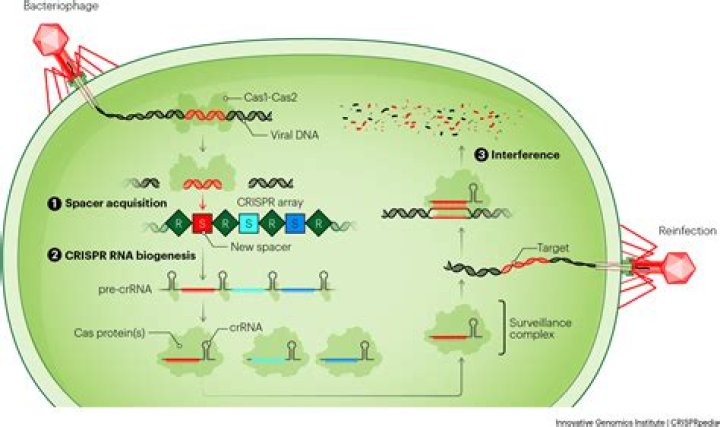
The CRISPR arrays allow the bacteria to “remember” the viruses (or closely related ones). If the viruses attack again, the bacteria produce RNA segments from the CRISPR arrays to target the viruses’ DNA. The bacteria then use Cas9 or a similar enzyme to cut the DNA apart, which disables the virus.
What is CRISPR and how does it protect bacterial cells?
CRISPR (clustered regularly interspaced palindromic repeats) is a defense mechanism, present in bacteria and archaea, which confers immunity against phages. … The CRISPR system protects prokaryotic cells by destroying viral DNA after it has entered the cell.
What is the role of CRISPR?
CRISPR is a powerful tool for editing genomes, meaning it allows researchers to easily alter DNA sequences and modify gene function. It has many potential applications, including correcting genetic defects, treating and preventing the spread of diseases, and improving the growth and resilience of crops.
Can CRISPR be used on bacteria?
First, CRISPR can be used to target locations in the genomes of pathogenic or undesirable bacteria. This system can be delivered a number of ways but success has been observed with Phagemids (Selle et al., 2020, Citorik et al., 2015, Bikard et al., 2014).What role does CRISPR play in prokaryotes?
The key function of CRISPR system is to provide immunity in prokaryotes, and the expression of this system’s defense mechanism might be due to invasion of extra chromosomal elements.
Does CRISPR work in E coli?
We demonstrated in this study that CRISPR-Prime Editing system cannot only make substitutions but also insertion, deletion, and combinatorial editing at single base pair resolution in E. coli without requiring DSBs, editing templates, or homologous recombination.
What does CRISPR do in E coli?
Clustered, regularly interspaced, short palindromic repeats (CRISPRs) were initially discovered in Escherichia coli (19) and have been recently identified in most archaea and many bacteria (35). CRISPRs provide acquired immunity against viruses and plasmids by targeting nucleic acid in a sequence-specific manner (18).
What are the benefits of CRISPR?
The CRISPR-Cas9 system can modify DNA with greater precision than existing technologies. An advantage the CRISPR-Cas9 system offers over other mutagenic techniques, like ZFN and TALEN, is its relative simplicity and versatility.What is the purpose of CRISPR quizlet?
CRISPR is a bacterial system that bacteria use to fight viruses. It consists of an enzyme called Cas9 and a guiding RNA. Cas9 works together in a complex with the guide RNA to be directed to the complementary sequence of a gene that is being targeted where a ds break will be generated.
What is CRISPR simple explanation?CRISPR is a technology that can be used to edit genes and, as such, will likely change the world. The essence of CRISPR is simple: it’s a way of finding a specific bit of DNA inside a cell. After that, the next step in CRISPR gene editing is usually to alter that piece of DNA. … CRISPR has made it cheap and easy.
Article first time published onWhat is the function of CRISPR-Cas in prokaryotes quizlet?
What does it stand for? Cas9 or CRISPR associated protein 9 is a RNA directed nuclease enzyme that uses CRISPR sequences as a guide to recognise and cleave specific strands of DNA that are complimentary to the CRISPR sequence.
Is CRISPR a natural immune response in bacteria?
Although there are several innate immunity-like systems in bacteria, such as abortive infection, receptor mutation, and restriction-modification, the recently characterized CRISPR-Cas system has been described as an adaptive immune system, which provides specific and acquired immunization against exogenic mobile …
How does CRISPR behave as a form of bacterial adaptive immunity?
How does CRISPR behave as a form of bacterial adaptive immunity? Spacer sequences provide a molecular memory of past viral attacks. … A bacterial operon is responsible for the production of biosynthetic enzymes needed to make the hypothetical amino acid tisophane (tis).
What is CRISPR biology?
CRISPR stands for Clustered Regularly Interspaced Short Palindromic Repeats. They’re really just bits of genetic code with a specific, recognizable format. They contain a sequence that shows up over and over again, though it’s often reversed each time.
What is BAC Recombineering?
Bacterial artificial chromosome (BAC) recombineering is a novel technique for DNA manipulation. It starts from an original chromosomal gene locus that is modified to introduce a transgene under the expression control of the original gene locus.
Do plasmids replicate?
The plasmid is a small DNA molecule within a chamber that is physically separated from chromosomal DNA and can replicate independently [6].
Can you use CRISPR on plasmids?
Plasmids Demonstrate Variable CRISPR Editing Efficiencies. Plasmids may also have a quality problem. When CRISPR components are transfected as plasmid DNA, transcription (of gRNA and Cas9) and translation (of Cas9) need to occur within the cell before any genome editing occurs.
How does CRISPR target the gene of interest?
CRISPR targets the gene of interest by with the help of Cas9 enzymes which target the DNA. … CRIPSR-Cas9 can be tailored to target different genes by RNA that attaches to the DNA sequences in the genome. This can target specific DNA sequences in the genome from the RNA sequences.
What is the history of CRISPR?
CRISPRs were first identified in E. coli in 1987 by a Japanese scientist, Yoshizumi Ishino, and his team, who accidentally cloned an unusual series of repeated sequences interspersed with spacer sequences while analyzing a gene responsible for the conversion of alkaline phosphatase.
What was the original role of the CRISPR system and what is the role of Cas9 in genome editing?
CRISPR-Cas9 was adapted from a naturally occurring genome editing system in bacteria. … If the viruses attack again, the bacteria produce RNA segments from the CRISPR arrays to target the viruses’ DNA. The bacteria then use Cas9 or a similar enzyme to cut the DNA apart, which disables the virus.
In what cells were CRISPR originally discovered and what is their purpose in that type of cell quizlet?
CRISPR was first identified in E COLI. The two main parts of CRISPR DNA are REPEATS, which are short segments of DNA that are palindromes, meaning transcribed RNA can form HAIRPINS. These are all IDENTICAL and interspaced, and used to mark off and help bacteria find SPACERS.
Which of the following is the function of CRISPR in bacterial cells quizlet?
Why do bacterial cells have the CRISPR function, what is its “natural” function? Defense against invasion by phages. It provides “memory” of prior exposure to phage DNA. It involves CRISPR sites in DNA and a protein, Cas.
What is the promise of CRISPR?
CRISPR gene-editing technology can improve the drug development process by directly upregulating or downregulating gene(s) to determine which gene products are responsible for disease. This enables researchers to identify more effective drug targets to speed up drug discovery.
How does CRISPR impact society?
CRISPR is having a major impact on diagnostics and therapeutics, where it allows medicine to become more personalized. Treatments for cancer and blood disorders are furthest along because of how CRISPR is performed, she said. “The most tested medical applications of CRISPR have been for cancer.
How does CRISPR affect the environment?
CRISPR also has a field of application in reducing greenhouse gas emissions from agriculture and livestock. Flooded rice fields are the largest anthropogenic source of methane. Genetic techniques have previously been applied to produce low-emission varieties, a goal now made more attainable by CRISPR.
How do you explain CRISPR to a child?
CRISPR is a term used in microbiology. It stands for Clustered Regularly-Interspaced Short Palindromic Repeats. These are a natural segment of the genetic code found in prokaryotes: most bacteria and archaea have it. CRISPR has a lot of short repeated sequences.
In what ways does Crispr Cas9 benefit a bacterial cell quizlet?
The CRISPR arrays allow the bacteria to “remember” the viruses (or closely related ones). If the viruses attack again, the bacteria produce RNA segments from the CRISPR arrays to target the viruses’ DNA. The bacteria then use Cas9 or a similar enzyme to cut the DNA apart, which disables the virus.
What bacteria does CRISPR come from?
The first hint of their existence came in 1987, when an unusual repetitive DNA sequence, which subsequently was defined as a CRISPR, was discovered in the Escherichia coli genome during an analysis of genes involved in phosphate metabolism.
Is CRISPR an immune response?
Clustered Regularly Interspaced Short Palindromic Repeats (CRISPR) and CRISPR- associated (Cas) proteins constitute an RNA-guided adaptive immune system found in several bacteria and most archaea.
How is CRISPR an adaptive immune system quizlet?
CRISPR is the name of an adaptive immune system found in bacterial species that permits foreign (viral) DNA to be recognized, cleaved , and ultimately degraded. This system allows cells to keep a kind of record of previous viral infections and respond by destroying similar viral genomes effectively in the future.
What was the key experiment that showed that the CRISPR and cas genes served an immunity function in bacteria?
The function of the CRISPR-Cas system as a prokaryotic acquired immune system was finally experimentally proven in 2007, using the lactic acid bacterium Streptococcus thermophilus in 2007 (28). Insertion of the phage sequence into the spacer region of the CRISPR of S.