What is civil obligation and natural obligation
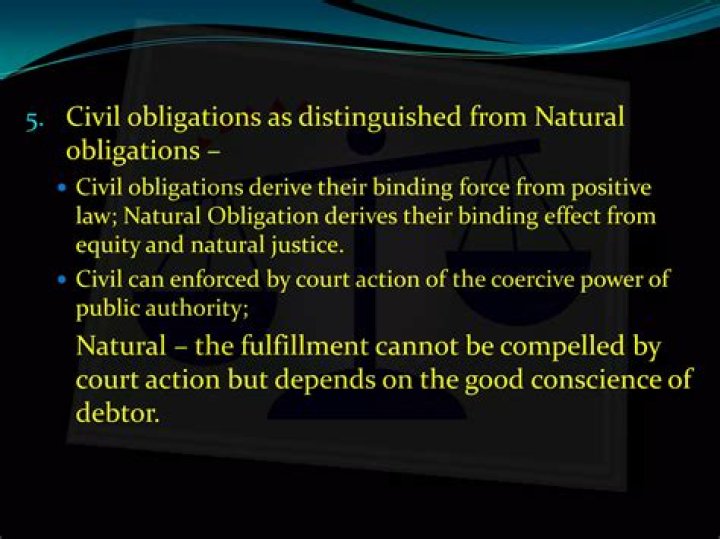
Civil obligations (also called perfect obligations) must be distinguished. from natural obligations, which are not subject to any legal necessity.
What is civil and natural obligation?
A natural obligation is one which can not be enforced by action, but which is binding on the party who makes it, in conscience and according to natural justice. … A civil obligation is a legal tie, which gives the party, with whom it is contracted, the right of enforcing its performance by law.
What is natural obligations in law?
NATURAL OBLIGATION, Civil law. One which in honor and conscience binds the person who has contracted it, but which cannot be enforced in a court of justice.
What does civil obligation mean?
This term is given to the obligation that can be enforced through a civil suit or action in a court.What is civil obligation example?
According to the Civil Code, under an obligation one person (debtor) is obliged to perform a certain action in favor of another person (creditor), such as paying money, transferring property, performing work, rendering services, etc., or evading a certain action, and the creditor has the right to demand that the debtor …
Where are civil obligations based?
An obligation are civil or natural. Civil Obligation is based on a positive law and gives right of action to compel their performance, while Natural Obligation is based on natural law, but on equity and moral justice.
What is nature of obligation?
A “natural obligation” may be defined as an obligation that does not. give rise to an action to enforce it, but that does have some cognizable legal. effects. Natural obligations provide an odd instance where a creditor does have. a right without a remedy, or at least the traditional remedy.
What is a natural obligation Art 1423?
ART. 1423. Natural obligations, not being based on positive law but on equity and natural law, do not grant a right of action to enforce their performance, but after voluntary fulfillment by the obligor, they authorize the retention of what has been delivered or rendered by reason thereof.Is natural obligation a valid obligation?
A natural obligation is an obligation that has no legal basis and hence does not give a right of action to enforce its performance. It is based on equity, morality, and natural law, and should be voluntary.
What are the types of obligation?- absolute obligation.
- contractual obligation.
- express obligation.
- moral obligation.
- penal obligation.
What are the examples of natural obligations under the law?
Examples of natural obligations: (1) A debtor who willfully and voluntarily performs his contractual obligations cannot recover what he has delivered or the value of the services he rendered on the ground that the creditor’s right to file suit has lapsed by extinctive prescription (Article 1424, Civil Code); (2) A …
What are the 3 kinds and 4 elements of obligation?
Every obligation has four essential elements: an active subject; a passive subject; the prestation; and the legal tie.
Who said that each person has a natural obligation to achieve?
Locke famously appeals to the notion of tacit consent in order to accommodate special political obligations given his voluntarist commitment: “every man, that hath any possessions, or enjoyment, of any part of the dominions of any government, doth thereby give his tacit consent, and is as far forth obliged to obedience …
Is law a natural?
Natural law is a theory in ethics and philosophy that says that human beings possess intrinsic values that govern their reasoning and behavior. Natural law maintains that these rules of right and wrong are inherent in people and are not created by society or court judges.
What is the example of obligation?
The definition of an obligation is something that someone is required to do. An example of obligation is for a student to turn in his homework on time every day. A moral or legal duty to perform or to not perform some action.
What are the 5 sources of obligations?
- Law.
- Contracts.
- Quasi-contracts.
- Crimes or acts or omissions punished by law.
- Quasi-delicts or torts.
What is nature and effect of obligation?
Art. 1163. Every person obliged to give something is also obliged to take care of it with the proper diligence of a good father of a family, unless the law or the stipulation of the parties requires another standard of care. ( 1094a)
What is the nature of obligation in jurisprudence?
Obligation is a legal bond between two individuals which control each other not in all respect but just to perform any particular action. Obligation is that part of law which creates right of one person over another.
Where did natural obligations originate?
Terms in this set (16) Natural obligations originated in the Roman law where they grew in importance in order to temper with equity and justice the severity of the _____.
What is the difference between obligations and contracts?
What Is the Difference Between Contract Rights and Obligations? The difference between contract rights and contract obligations is that one is a benefit you are receiving from the contract while the other is a duty or responsibility that you promised to perform under the contract.
What is meant by reciprocal obligation?
In law, a reciprocal obligation, also known as a reciprocal agreement is a duty owed by one individual to another and vice versa. It is a type of agreement that bears upon or binds two parties in an equal manner.
Is there a delay in natural obligation?
-Demand necessary even a period has been fixed in the obligation. –There is no delay/default if there is no demand.
What is Negotiorum gestio example?
This form of intervention is classified as a quasi-contract and found in civil-law jurisdictions and in mixed systems (e.g. Louisiana, Scots, South African, and Philippine laws). For example, while you are traveling abroad, a typhoon hits your home town and the roofing of your house is in danger.
What is pure obligation?
A pure obligation is an obligation that is demandable since it has no condition and there is no specific date stated or mentioned. 2. Condiional Obligaions. A conditional obligation is an obligation that one whose consequences are to comply one way or another for its fulfillment.
Is civil obligation based on positive law?
A civil obligation (as defined in Art. 1156) is based on positive law; hence, it is enforceable by court action. … The obligation, however, exists in equity and moral justice, such that if the debtor voluntarily performs it, he can no longer recover what he has given.
What is the meaning of social obligations?
Social obligation is the requirement that organizations have a positive impact on people and planet. This goes beyond cosmetic issues of reputation to the requirement that the operations of a firm have a fundamentally positive impact.
What is personal obligation?
Personal Obligations means any liability or other obligation accrued, incurred or payable by the Company to or for the benefit of Gold, Daniels, Swanson, Lucky Good Dog or any of them.
What is modal obligation?
We can use modals to express obligation. An obligation is a necessity, or something you have to do. … When you have no choice in the matter, you can use the modals must or have to in order to express this.
What are the basic concepts of obligation?
Obligation exists when there is a choice to do what is morally good and what is morally unacceptable. There are also obligations in other normative contexts, such as obligations of etiquette, social obligations, religious and possibly in terms of politics, where obligations are requirements which must be fulfilled.
What is the difference of duty and obligation?
In the professional world, the terms “duties” and “obligations” are often used interchangeably. … An act of duty comes from a moral or legal necessity, according to DiffSense. An obligation, on the other hand, arises out of a set of rules aimed at maintaining order that one has signed himself up for.
What is Article 1156 all about?
The definition of obligation in Article 1156 refers to civil obligations which are enforceable in court when breached. It does not cover natural obligations. … It deals with the spiritual obligation of a person in relation to his God or Church.